61° and Overcast



Image
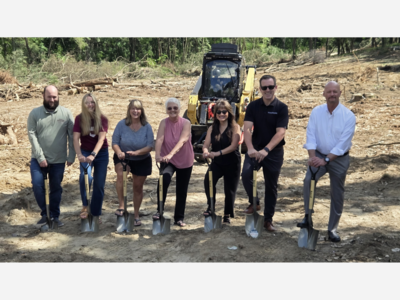
The city heard a report from leaders of the Risk Mitigation Working Group , an advisory body authorized by Saline City Council. Laurie Champion, the group's facilitator since its inception, and Dean Girbach, its chair, addressed council on the group's work. Mayor Brian Marl, Councillor Jim Dell'Orco, Mitch Rohde and Nicholas Hopkins also work on the group.
Champion explained the group's purpose.
"Understand what the risks are, and prioritize those based on how likely they are to happen and how impactful they might be," Champion said. "The basic point is to help understand what the risk profile is and then to focus on the things that are most potentially harmful, and get ahead of those and take action"
Girbach told council that the working group has done exactly that.
"In some cases we've seen things go from a very high risk to a lower risk because we've put things in place," Girbach said.
The city's rotating city manager issue means some issues have been "put on hold," Girbach said.
The working group keeps some of its work quiet, in order to prevent some vulnerabilities from becoming known, Girbach said.
Champion said the group convenes annually to identify risks, evaluate how likely the risks are, and how impactful they may be. Then the group works with city staff to identify ways to get in front of the risks, she said.
Champion said there have been great examples of improving risk. She pointed to the ongoing work at the wastewater treatment plant, employee health and safety.
"At the beginning of the project we saw there were different practices in different parts of the city and differnt departments," Champion said. "The project recommended there be a more aligned approach, making sure that everyone had the right personal protective equipment, and that the training was done correctly."
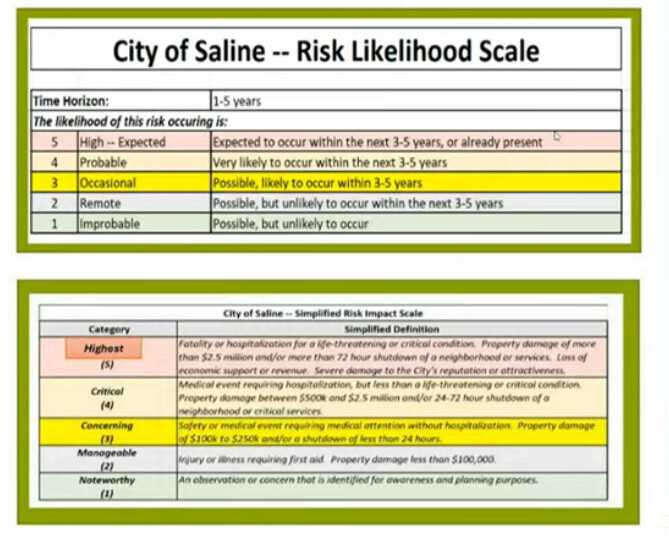
Girbach pointed to improving processes, like the building permit process, as a way to address risks. On the risk-likelihood scale, the group rated a water tower failure as 1 because, while possible, it's very unlikely.
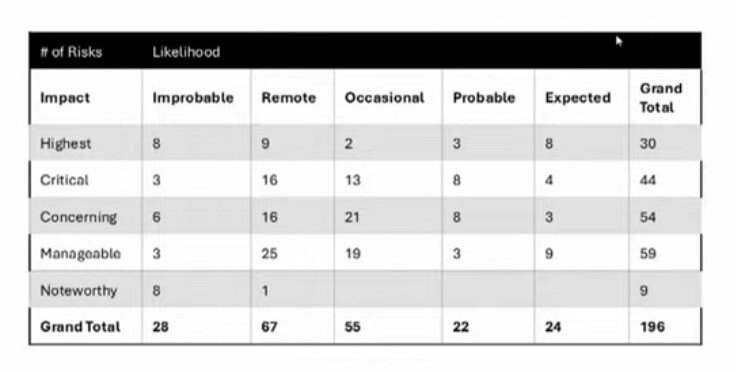
The group has identified 196 risks. 30 of those are considered the highest risk. Eight of those are expected to be expected.
"One of them is the funding for the fire department," Girbach said. "A majority of the risks are manageable. We're working towards maintaining them and watching them. It's, of course, all on the staff and city manager to monitor this."
Girbach said Risk Management is just functioning to identify issues and monitor them.
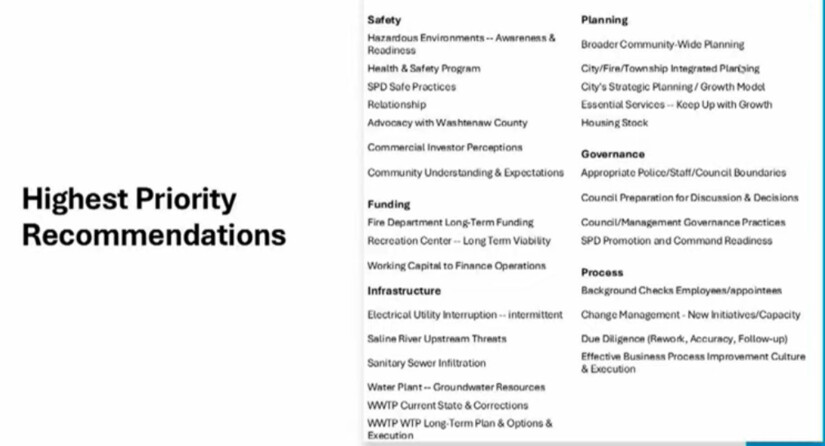
Girbach talked about funding for the fire department.
"We hope that the millage will resolve that," Girbach said.
He pointed to the Rec Center and working capital to finance city operations. He pointed to contamination issues in the Saline River as an emerging concern.
"The real goal is, how does council want to handle this, moving forward," Girbach said.
Champion said the working group is an advisory body.
"It should be something where we are bringing the outside perspective and expertise, but it's the leadership and the council who see the inner workings. So we need to do that part together," Champion said.
She invited council to join the group for a two-hour workshop to go through the risk matrix.
Champion said the city needs someone on staff to "manage the workbook."
"What are the things the city can afford to do, in terms of money and time, to align risk mitigation planning with the budget, with the workplan, with people's time? Do you have the expertise within the city? Do you have the right resources within the city or do you need to go out and get some help?" Champion said. "There's a lot we can do from an advisory perspective, but we are not within the city with a leadership perspective to drive the risk mitigation work."
She said the 196 risks were in six areas on the spreadsheet, and that's where the focus should be. She recommended the city not get hung up on software or the big "196" number.
"They either try to do 196 things, or they do zero things. One cure for that is focusing on those six projects and trying to knock those out," Champion said.
Recommendations


Overcast, with a high of 63 and low of 56 degrees. Overcast during the morning, patchy rain nearby in the afternoon, overcast in the evening,


Tell us about a time when you made a decision that you later realized was wrong...The answer to this question is to reveal how intellectually premeditated the person answering is.
Long overdue for change at city hall and that starts with the Mayor. I’m voting for McVey!
The challenger for the Mayors role was on the Saline Area School Board for many years. When he joined the Board, The Saline Area School District was the #7 rated High School in the State. While he served in Leadership of the School Board, the High School fell thirteen places to 20th.
Come on man, Michigan has approx 1,259 high schools. A drop from 4 to 17 is insignificant in these subjective rankings. Saline is still very much a top notch school, for you to say otherwise is unreasonable